
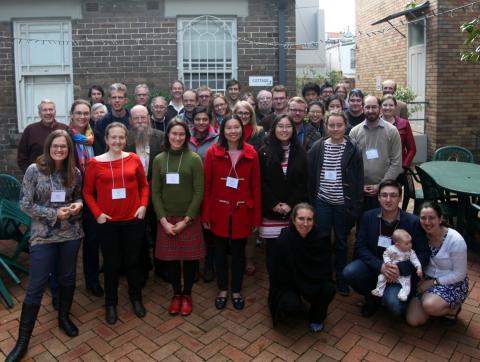
Last week, around 50 delegates from across the country gathered for the third annual Write Conference. It was a thought-provoking and inspiring weekend, as academics from a range of disciplines explored the relationship between their research and the Christian faith. Amongst the delegates were historians, philosophers, scientists, economists and anthropologists (to name a few!), with over 15 different universities and institutions represented. In the opening address, the tone was set for the weekend with the words of 2 Corinthians 5, which reminds us that "Christ's love compels us" as we pursue truth and seek to make Christ known at our universities.
The opening session featured a series of excellent papers discussing shifting trends in the humanities and their impact on public views of Christianity. In a paper titled "History takes time", Mark Hutchinson (The Scots College) reflected on the counter-modernism of the historian's pursuits in a fast-paced world, and the disappearance of history from contemporaty public discourse. Lachlan Brown (Charles Sturt University) examined the emergence of the conceptual writing genre and reflected on its potential to alter biblical reading practices. And in a case study of "how to listen to the other side", Chris Watkin (Monash University) reflected on his experiences of combining Jaques Derrida with reformed theology.
Other notable papers included Howard Doran (University of New England) and Gordon Menzies' (University of Technology, Sydney) Can miracle scepticism be unscientific?, which used Baysian probability theory to highlight the scientific inconsistencies in extremely sceptical attitudes to miracles such as the resurrection of Jesus. Also generating much interest was Peggy Kern's (University of Melbourne) reflections on the confluence and divergence of positive psychology and biblical thinking.
One of the highlights of the conference was hearing from Graeme Finlay, a cell biologist and cancer researcher from the University of Auckland. At the conference dinner, he reflected on his upbringing as a missionary's son in Singapore, and his experiences of writing and publishing as a scientist. In a later talk, he presented the evidence for evolution from retroviral DNA studies, showing that common ancestors could be identified by the sequencing of retroviruses in the genetic code. He stated that his purpose in bringing such evidence to light was to "address the pain that exists between many Christians over the issue of evolution". He also discussed the relationship between genetics and personhood, reflecting that "genetics is not enough to generate a human being, our humanness comes from relationship". Or in the words of John 17:3, "And this is eternal life, that they know you the only true God, and Jesus Christ whom you have sent."
The vision for Write is to provide a public platform for the discussion of the intersection of research and Christianity. The standard of this year's papers was unprecedently high, with the hope that many will be made available to the public. With this in view, a number of delegates stayed on for the inaugural Publish Workshop, which was designed to help researchers polish their work for publication in peer-reviewed journals.
Many thanks to all those who were involved in organising the conference. See photos from Write here.